Best Programmatic SEO Examples to Learn From in 2026
Programmatic SEO is one of the most efficient ways to scale organic search visibility, and the best way to understand it is to study the companies already doing it well.
In this article, you'll see exactly how seven brands use templates, structured data, and repeatable keyword patterns to create pages automatically and capture millions of long tail keywords.
What You'll Learn From These 7 Programmatic SEO Examples
Below, you'll find 7 concrete, real-world programmatic SEO examples alongside the repeatable patterns behind them. Each one demonstrates a different way to turn a database into thousands of search-optimized web pages.
Yelp - "[Business category] in [City]" pages powered by business listings and user reviews. Yelp receives over 135 million visits per month through programmatic SEO.
Indeed - "[Job title] jobs in [Location]" pages driven by real-time job feeds.
Realtor.com - "[Property type] for sale in [City/Neighborhood]" pages layered across a deep geographic hierarchy.
Booking.com - "[Hotels] in [Destination]" pages with live pricing, reviews, and multilingual localization.
Rome2Rio - "[Origin] to [Destination]" route pages covering 10 million-plus locations globally.
Weather.com - Entity pages for every city, town, ZIP code, or coordinate with dynamic weather data.
Numbeo - Location + dataset pages covering cost of living, crime, rent, and quality of life.
Each example follows a clear keyword pattern powered by a structured data source and a repeatable page template. Beyond the examples themselves, this article shows how to avoid duplicate content and thin programmatic pages when you create programmatic SEO pages yourself.
For context on the sheer scale possible: Zapier generated 56,000 pages, attracting 2 million visitors in May 2022, and Canva targets thousands of long-tail keywords with design template pages - from instagram post templates to business card layouts.
Programmatic SEO can generate thousands of pages quickly when the underlying data and template are solid.
What to Look For in Each Programmatic SEO Example
Every strong programmatic seo strategy combines 3 pillars:
keyword pattern;
relevant data;
robust page template.
When you study the examples below, pay attention to how each brand executes on all three, because missing even one pillar produces pages that Google ignores.
Example #1: Yelp – Business Category + City Pages
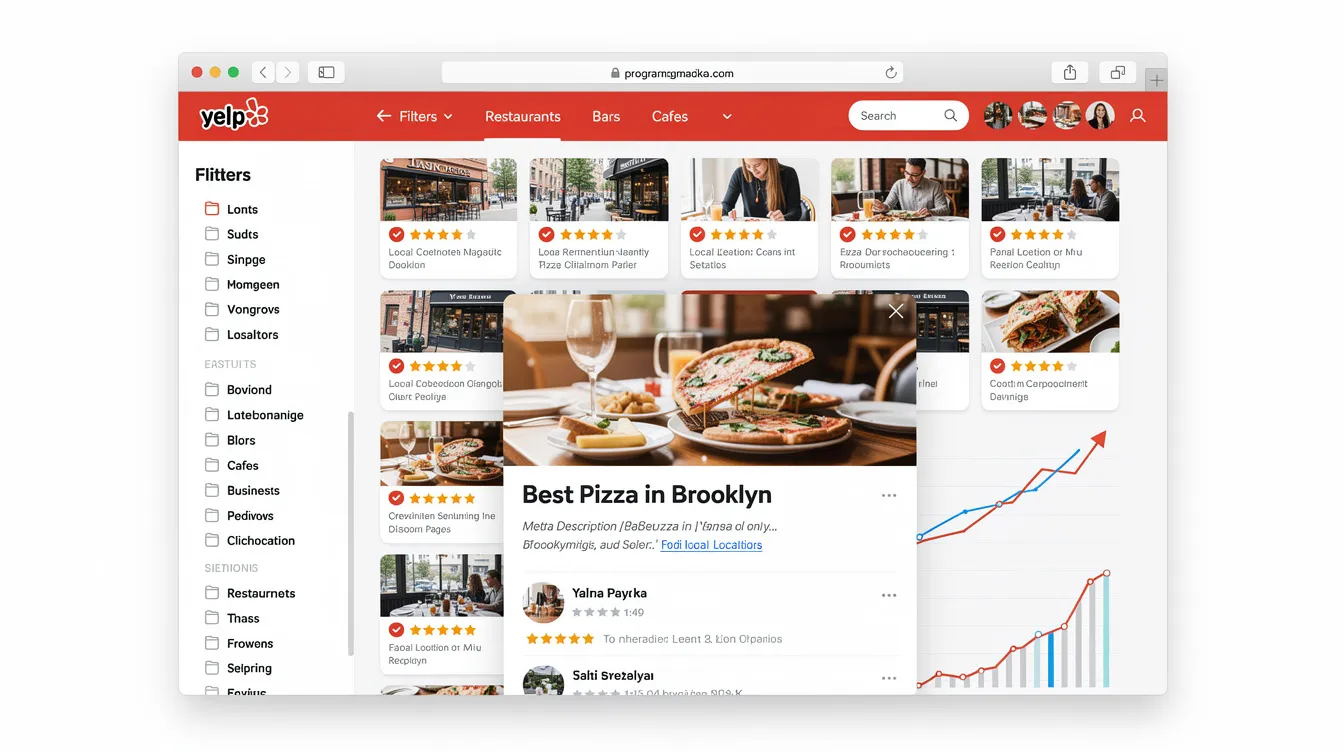
Yelp is a classic programmatic SEO example built on "[Business category] in [City]" pages. Think "Italian Restaurants in Chicago" or "Plumbers in Seattle."
The primary keyword pattern [Business type] in [City] can generate millions of programmatic pages across the US, Canada, the UK, and more because Yelp maintains over 1,500 business categories, each combinable with thousands of geographic locations. Yelp generates pages for over 150 cities programmatically, and thanks to this approach, the site ranks for over 10 million keywords.
The structured data source powering these pages is a business database with fields like name, address, opening hours, ratings, review count, price range, and photos. Every business listing feeds location data and category tags into the template, ensuring each generated page contains its own set of listings.
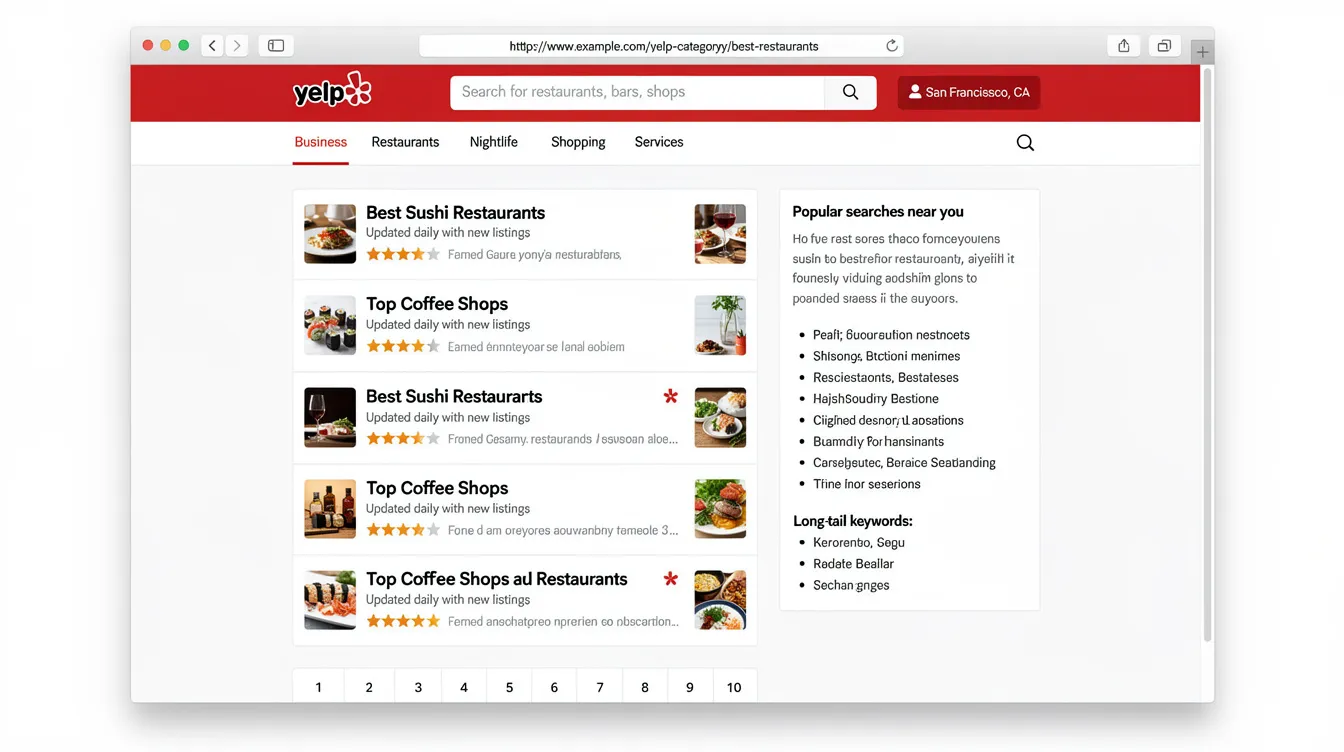
Here are the components present in each programmatic page on Yelp's website:
Dynamic H1 and meta titles tuned for the specific category-city combo
Filter sidebar letting users narrow by price, distance, and features
Map integration showing business pins
Sortable business list with ratings, review counts, and photos
Internal links to nearby neighborhoods and related pages in adjacent categories
Since each page has its own set of listings, Google doesn't treat them as several duplicated pages. Instead, each URL delivers its own value and usefulness for the reader. Yelp avoids thin or duplicate content by relying on user reviews, photos, and dynamic ranking algorithms rather than repeating boilerplate copy on every city page. Each location-category page has genuinely different listings, review text, and ratings - the data itself is the content. User generated content keeps these web pages fresh without any manual rewriting, which is a major advantage for local SEO at this scale.
Example #2: Indeed – Job Title + Location Search Pages

Indeed is a job search engine whose core programmatic SEO pattern is [Job title] jobs in [Location], e.g., "Software Engineer Jobs in London" or "Nurse Jobs in New York, NY." This pattern mirrors Yelp's formula, but instead of businesses, the entities are live job postings.
Each programmatic page is generated from a live job listings index, pulling in job title, employer, salary estimate, posting date, and job type (full-time, remote, contract). Indeed's XML job feeds require unique identifiers for each posting - reference numbers, requisition IDs - ensuring every listing page has distinct data points.
The page template layout includes:
Search bar pre-filled with the target keywords
Filters for salary, distance, job type, and experience level
A scrollable list of job postings with employer, salary, and freshness indicators
Sometimes a salary estimate box or company rating module
Because user search intent behind these queries is primarily transactional - people want to apply, not read an essay - these pages are rarely disrupted by AI overviews in search results. Users still need to enter the website to browse and act on listings.
These pages match search intent perfectly. Indeed uses canonical tags and clean URLs (e.g., /q-software-engineer-l-london-jobs.html) to avoid parameter-based duplicate content across millions of search results pages.
The real differentiator compared to Yelp is real-time updates: as jobs expire and new ones appear, the automatically generated pages stay useful without manual rewriting. This is a textbook case of how programmatic SEO works to generate thousands of landing pages that remain relevant through data freshness alone.
Example #3: Realtor.com – Real Estate Listings + City or Neighborhood
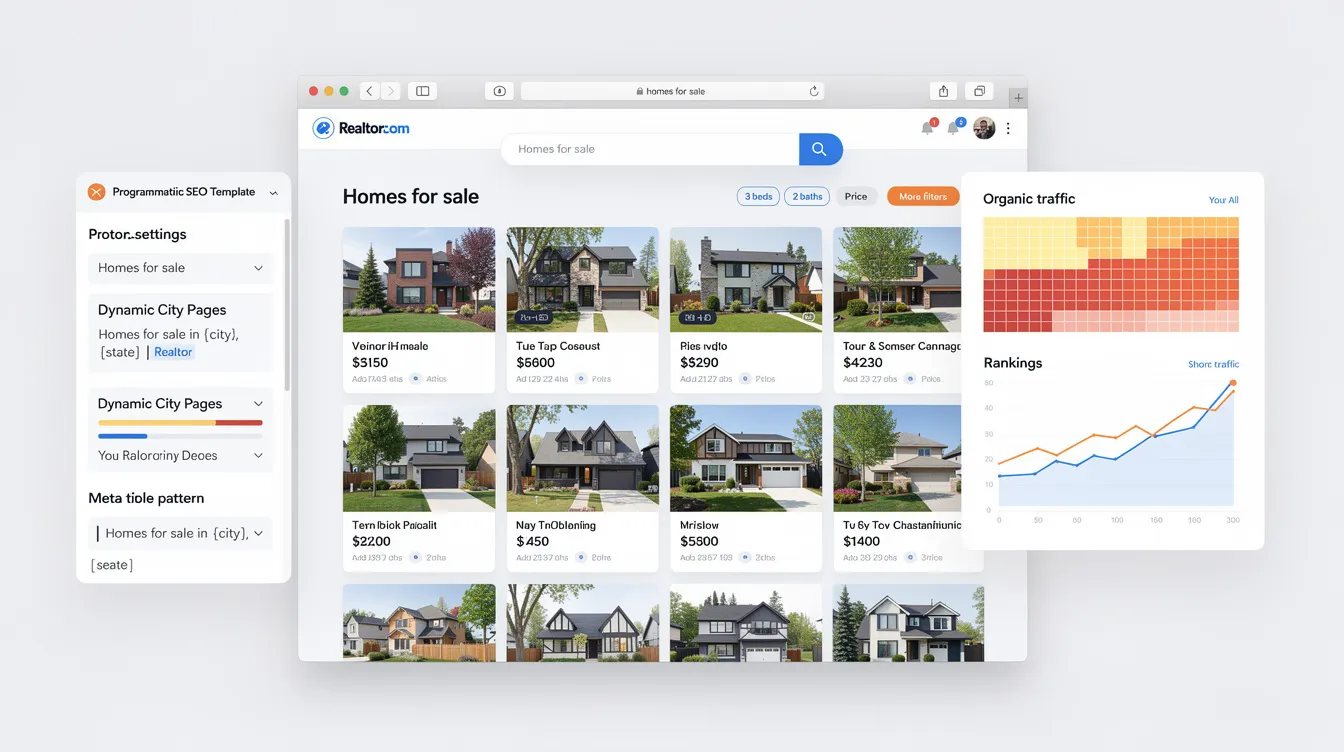
Realtor.com's pattern is [Property type] for sale in [City/Neighborhood], e.g., "Homes for Sale in Austin, TX" or "Condos for Sale in Brooklyn, NY."
Programmatic SEO is applicable for a variety of structured datasets including e-commerce catalogs and real estate listings, and Realtor.com proves just how deep the real estate use case can go.
The underpinning database includes MLS feeds with property price, beds, baths, square footage, photos, days on market, school ratings, and pricing data. This structured data source drives every individual page with distinct, location-specific numbers.
The page template structure includes:
H1 with city and property type
Market snapshot showing median price, days on market, and inventory count
Interactive map with property pins
Filters for price range, beds, baths, and property type
Card-based property listings with photos, price, and key details
Realtor.com uses subfolders and internal linking for deeper programmatic SEO pages. Neighborhoods, ZIP codes, new construction, and price ranges all get their own dedicated page, and all these location based pages create a hierarchy that search engines can crawl efficiently without impacting technical SEO metrics. Robust internal linking is vital for successful programmatic SEO due to the volume of generated content, and Realtor.com executes this well.
These types of programmatic SEO patterns also address search intent with unique content modules like "Austin housing market trends," FAQs, and nearby city links - turning what could be a thin listing page into something genuinely informative.
On top of this, schemas like FAQ and Product can boost eligibility for enhanced search results, and Realtor.com uses schema markup on property listings to reinforce the page structure for search engines.
Example #4: Booking.com – Hotels + Destination Pages

Booking.com is a global travel marketplace using programmatic SEO around [Hotels] in [Destination], e.g., "Hotels in Barcelona" or "Hotels in New York City." It's one of the most aggressive seo examples of scaling location pages across languages and geographies.
The data powering these pages includes property inventory with room types, prices by date, ratings, number of reviews, amenities, and distance to landmarks. Every hotel gets its own page, and every destination aggregates those hotels into a filterable directory.
The main page template sections include:
Search dates widget above the fold
Filters for price, rating, neighborhood, and amenities
List or grid of hotels with photos, star ratings, and review scores
Curated modules like "Best value in Barcelona" or "Most popular with families"
Booking.com addresses different user intent levels with layered programmatic pages: "Pet-friendly hotels in Barcelona," "Hotels with pools in Dubai," "Cheap hotels near Barcelona airport." These alternative pages capture long tail keywords that more generic pages would miss. Companies employing programmatic SEO often scale content without sacrificing page utility, and Booking.com demonstrates this at massive scale.
Then there's the multilingual angle: each location template is localized into dozens of languages, turning one destination into numerous localized programmatic SEO pages. This approach multiplies the keyword variations without creating duplicate content, because pricing data, availability, and reviews differ by locale.
User reviews, live pricing, and availability data keep Booking.com's pages dynamic. Content updates mean that even pages created years ago continue serving fresh, relevant data to searchers - a strong example of programmatic content done right.
Example #5: Rome2Rio – Origin × Destination
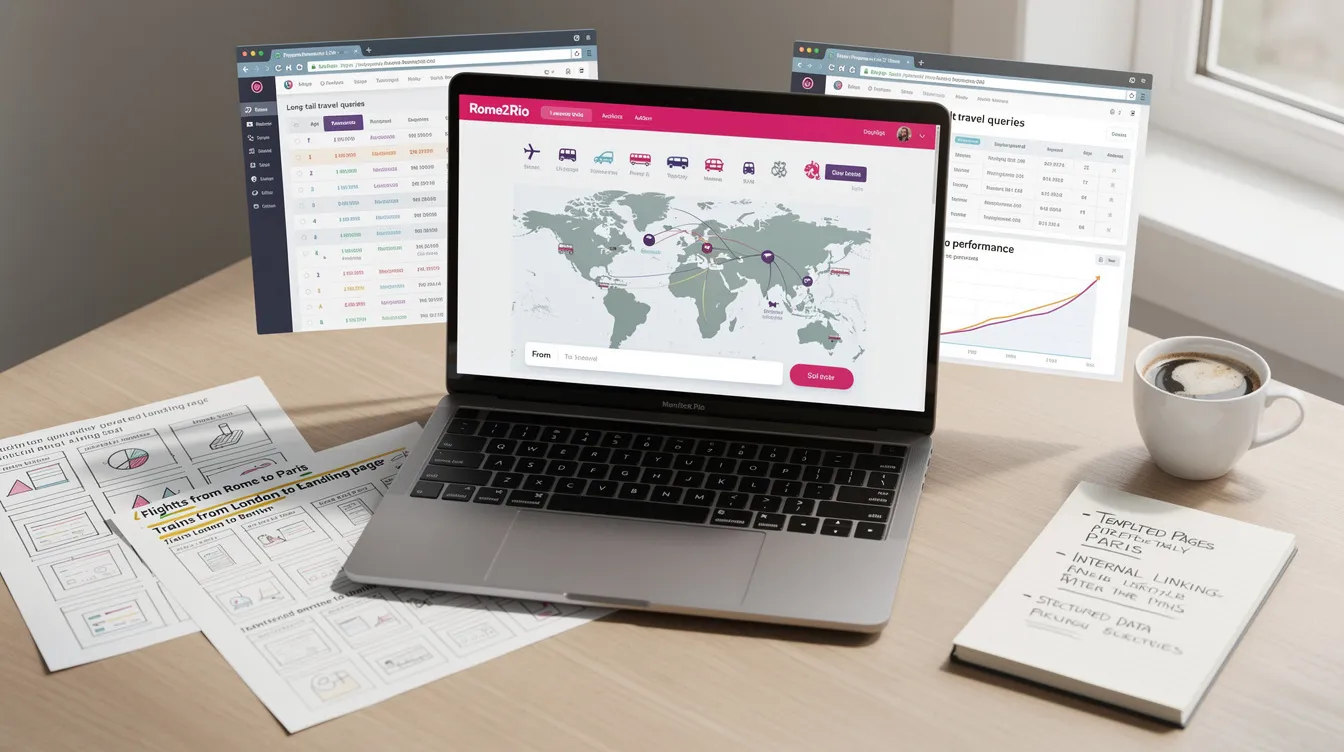
Rome2Rio's programmatic SEO pattern is [Origin] to [Destination], e.g., "Paris to Amsterdam" or "London to Edinburgh." Every page answers a single, specific search query: "How do I get from A to B?"
The data powering these pages comes from transport operator feeds including GTFS schedules, covering flights, trains, buses, ferries, and driving routes. Rome2Rio reports over 10 million locations globally across 240 countries and territories, supported by 20,000-plus transport operators. The mathematical scaling here is staggering: even a fraction of all possible origin-destination pairs generates millions of separate pages.
The page template for each route includes:
Multi-modal transport options ranked by speed, price, and convenience
Estimated travel times and costs for each mode
Map visualization showing the route
Booking links to transport providers
Alternative routes and nearby city connections
Each route page contains genuinely different data - travel times, costs, operator names, and transfer points vary from route to route. This makes every page a dedicated page with unique value, even though the page structure is identical. The template works because it's designed around clear user intent: someone searching "Paris to Amsterdam" wants actionable transport options, not a travel blog post.
The limitation? Some route combinations have minimal search volume. Pages for obscure origin-destination pairs may sit unindexed or unvisited, which is a crawl budget trade-off Rome2Rio accepts for breadth.
Example #6: Weather.com – Entity (Location) Pages
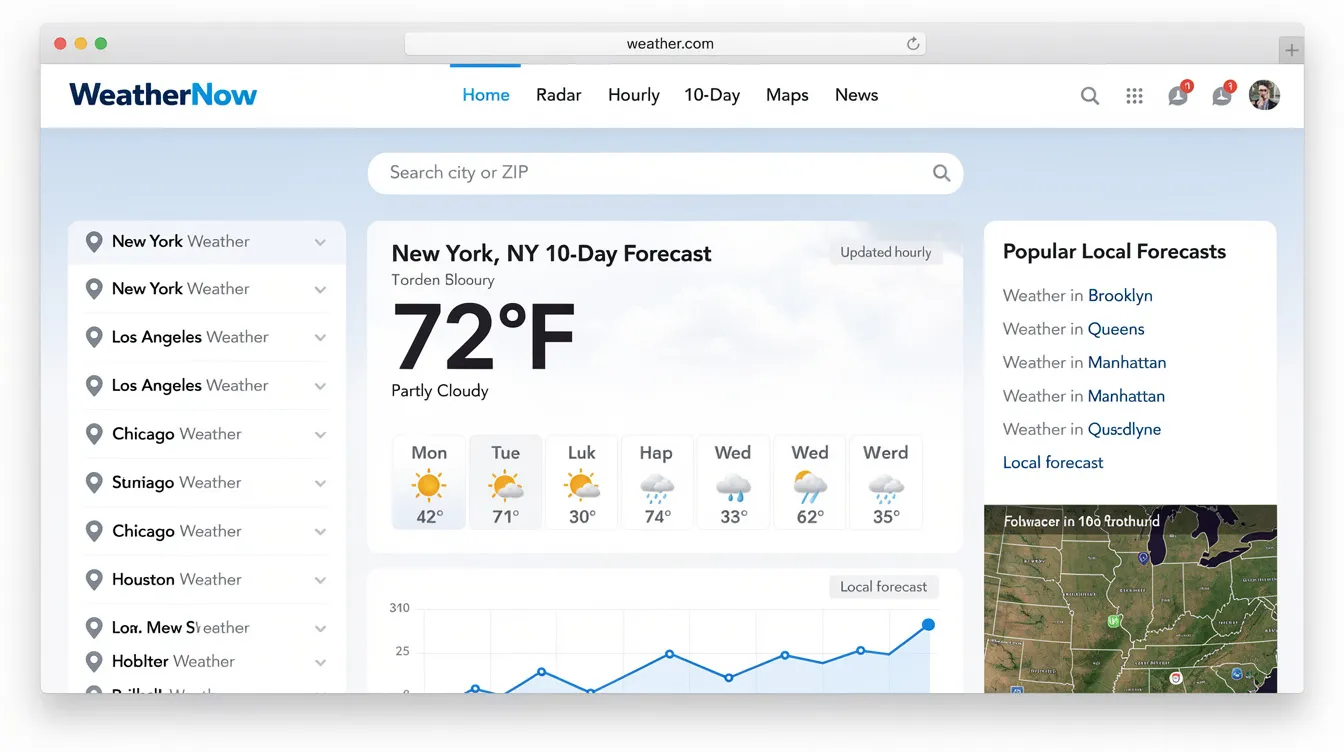
Weather.com's pattern is deceptively simple: one page for every city, town, ZIP code, or coordinate, each populated with real-time weather data. The keyword formula is essentially "[Location] weather" - a query pattern with enormous combined search volume.
The data comes from meteorological APIs delivering temperature, humidity, wind speed, precipitation forecasts, severe weather alerts, and historical averages. This data refreshes continuously, meaning every page is always current.
The page template includes:
Current conditions with temperature and weather icon
Hourly and 10-day forecasts
Radar and satellite maps
Air quality and UV index
Seasonal averages and historical comparisons
What makes Weather.com a strong programmatic SEO example is utility. Every page satisfies a specific search query with exactly the information the user needs - no filler, no boilerplate essays. The content varies meaningfully across pages because weather data is inherently location-specific. A page for "Denver, CO weather" and "Miami, FL weather" share the same template but display completely different numbers, forecasts, and alerts.
The technical know how required for this approach is significant: real-time data integration, API reliability, and page load performance are all critical. But the payoff is high-intent organic traffic at massive scale, with pages that deliver more traffic month after month as long as the data stays fresh.
Example #7: Numbeo – Location + Dataset
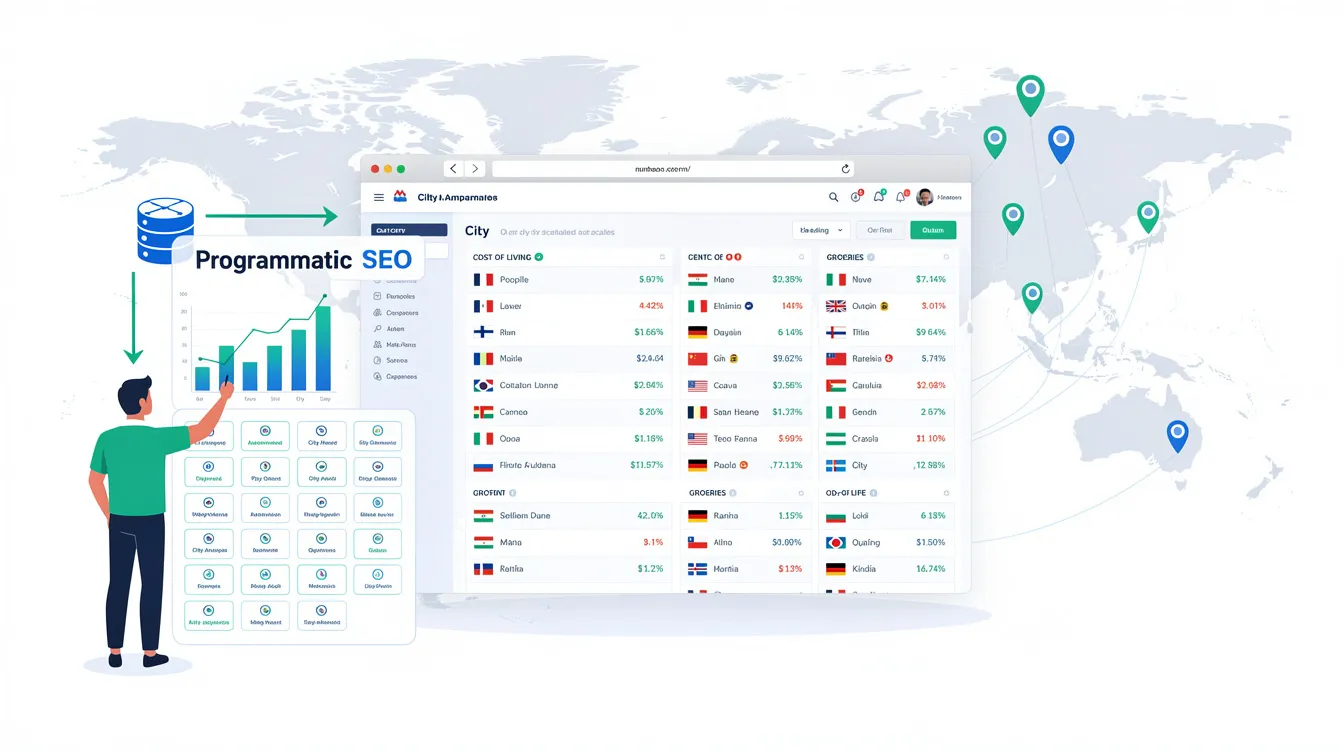
Numbeo builds programmatic pages around structured city-level datasets: cost of living, crime, rent, pollution, quality of life, healthcare, and traffic congestion. The keyword pattern is "Cost of living in [City]", "Crime in [City]", and similar dataset-city combinations.
The data comes from crowd-sourced surveys combined with governmental sources, refreshed periodically. Each city page has multiple sub-pages for different categories, so even though the page structure is repeated, the variance in numbers, sub-indexes, and graphs makes every page's content unique.
The template for each city dataset page includes:
Summary index score with comparison to national/global averages
Detailed data tables with individual line items (e.g., price of a meal, monthly rent)
Comparison tools to contrast two cities side by side
Charts and visualizations for trends over time
Related city links for neighboring locations
Numbeo demonstrates that data-driven insights can identify scalable keywords for programmatic SEO. Research-intent queries like "cost of living in Lisbon" or "crime rate in Cape Town" are perfectly served by such pages because searchers want hard numbers, not opinions. The data itself is the high quality content.
The challenge is collecting data and keeping it accurate. Cities with sparse survey responses may show outdated or incomplete numbers, which risks creating thin individual pages that undermine the site's credibility. Numbeo mitigates this by requiring minimum sample sizes before publishing.
How to Translate These Examples Into Your Own Programmatic SEO Strategy
The goal now is to move from inspiration to execution. Effective strategies for programmatic SEO include identifying scalable keyword sets and creating optimized templates, and the seven examples above give you a concrete starting point for both.
Here's a simple sequence:
Identify your core value - Do you have jobs, listings, services, tools, or products?
Find a scalable keyword pattern - What do people search when looking for your entities?
Collect relevant data - What database or feed can populate each page uniquely?
Build a flexible page template - Design once, deploy across all the data.
Launch a pilot batch - Start with 50–100 programmatic SEO pages to test indexing, organic traffic, and conversions before rolling out thousands.
Iterate based on performance - Use google search console to monitor what's getting indexed and what's earning clicks.
When designing your template, reference specific brand examples: Booking.com's use of filters and date pickers, Yelp's map-plus-list layout, or Realtor.com's market snapshot modules. These are website templates you can reverse-engineer.
An effective programmatic SEO strategy include data aggregation and technical optimization, not just content creation at volume!
Choosing Keyword Patterns for Programmatic SEO Pages
Keyword patterns (also called "formulas") are at the heart of scalable programmatic pages. Each programmatic page should target a specific long-tail keyword, and the pattern determines which specific keywords your entire page set will chase.
Wha you should do in this step is conducting a keyword research to identify high-volume, low-competition keywords that are worth building pages around.
Here are pattern examples inspired by the 7 brands:
"[Service] in [City]" - Yelp, Bark, WeddingWire
"[Job title] jobs in [Location]" - Indeed
"[Property type] for sale in [Area]" - Realtor.com
"[Location] weather" - Weather.com
"[Hotels] in [Destination]" - Booking.com
"[Origin] to [Destination]" - Rome2Rio
To do a proper keyword research, use keyword tools like Ahrefs, Google Keyword Planner, or SEMrush to confirm that each pattern plus modifiers has real search volume and low-to-medium competition.
The long-tail keywords that are usually perfect for a programmatic seo strategy, are usually very specific and less competitive, making them ideal targets for programmatic SEO.
Beyond search volume and competition, your keyword patterns should align with clear search intent. The best programmatic pages target queries where users are actively looking for a specific service, product, or information that your page can satisfy.
For example, imagine you run a directory of plumbers.
❌ Bad keyword pattern: "How to fix a leaking faucet in Chicago"
✅ Good keyword pattern: "Emergency plumbers in Chicago"
The first query has informational intent. The user is looking for advice or an explanation, not necessarily to hire a plumber. A directory page listing local plumbers is unlikely to satisfy that intent, making it difficult to rank and convert visitors.
The second query has transactional intent. The user is actively searching for a service provider, which matches the purpose of a directory page. This alignment between keyword intent and page content is what makes programmatic SEO effective.
Finally, be careful to avoid keyword cannibalization. This happens when multiple programmatic pages target essentially the same search query, causing them to compete against each other instead of strengthening your site's overall visibility.
For example, suppose your website generates both:
/plumbers/chicago
/emergency-plumbers/chicago
If the "emergency plumbers" page doesn't provide substantially different content and both pages are optimized for broad keywords like plumbers in Chicago, Google may struggle to determine which page is the better result. Instead of one page ranking well, both pages can end up underperforming.
To avoid cannibalization, ensure that each keyword pattern represents a distinct search intent and that every page has a unique purpose. Each URL should target a different query or user need rather than competing for the same keywords.
Collecting and Structuring Relevant Data for Programmatic Pages
High-quality, structured data is the difference between powerful programmatic SEO (like Yelp or Realtor.com) and thin, auto-generated pages that Google ignores. Using structured data instead of purely AI-generated text enhances the quality of programmatic SEO pages.
Potential data sources include:
Internal product databases - product category pages, pricing, specs
Public APIs - government datasets, MLS feeds, job feeds
Partner feeds - hotel inventory, service provider directories
User generated content - reviews, ratings, photos, Q&A
Web scraping - collecting data from public sources where permitted
A few concrete mappings from our examples:
Data Source | Programmatic Page Type | Example Site |
|---|---|---|
Business listing database | Category × City directory | Yelp |
XML job feeds | Job title × Location search | Indeed |
MLS property feeds | Property type × Neighborhood | Realtor.com |
Hotel inventory API | Destination × Accommodation | Booking.com |
GTFS transport schedules | Origin × Destination routes | Rome2Rio |
Meteorological APIs | Location weather pages | Weather.com |
Crowd-sourced surveys | City × Dataset statistics | Numbeo |
Store all the data in well-structured tables - SQL, Airtable, or even google sheets for smaller projects - with clearly named fields that map directly to slots in the page template.
Validate and deduplicate your data before publishing. Broken links, outdated listings, and duplicate entries create thin pages and waste crawl budget. Structured, differentiated data is vital to avoid thin content penalties in programmatic SEO. A single empty page can signal to search engines that your entire page set is low quality.
Designing a Reusable Page Template (Without Creating Duplicate Content)
A single well-designed page template can power thousands of seo optimized pages if it's structured around user intent, not just relevant keywords. Page templates must provide unique, useful experiences for users on every single URL.
Key sections a template often needs:
H1 and intro tuned to the target keyword pattern, with a unique meta description per page
Dynamic data modules - lists, maps, tables, pricing data
Filters and sorting to let users refine search results
FAQs pulling in location- or category-specific questions
Contextual CTAs aligned with the page's commercial intent
Reference specific layouts from our examples: Yelp's list + map or Booking.com's filters + date picker. Each of these designs surfaces dynamic content that varies meaningfully from page to page. Canva, for instance, ranks for 500,000-plus design-related keywords by giving every template - from resume layouts to social media graphics - its own page with interactive previews.
To avoid duplicate content risks, templates should never rely on generic text blocks repeated verbatim. Instead, pull city names, listing counts, median prices, and local stats into sentences so that each page reads differently. Adding unique local or category-specific elements - mini city guides, local pricing insights, condition-specific educational content - ensures each page feels distinct even with the same skeleton.
Handling SEO Risks: Duplicate Content, Thin Pages, and Crawl Budget
Programmatic SEO at scale comes with real risks. The most common are thin or duplicate content, crawl budget waste, and indexing issues that prevent your highest-value pages from being discovered by search engines.
Many programmatic SEO projects fail not because the idea is flawed, but because they generate thousands of pages that provide little unique value. Search engines are increasingly good at recognizing pages that exist solely to target keywords without offering meaningful content.
Duplicate content in this context refers to pages that are nearly identical except for a variable such as the city or service name. For example, if your pages for "Plumbers in Chicago" and "Plumbers in Boston" contain the same introductory text, headings, and structure (with only the location swapped) they offer little unique value. When a large portion of the content is repeated across pages, search engines may choose not to index some of them or may struggle to determine which version should rank.
To avoid this, every generated page should contain enough unique information to justify its existence. If a page doesn't have sufficient data (such as listings, reviews, statistics, FAQs, images, or locally relevant information) it's often better not to publish it at all.
Here are a few ways to make programmatic pages genuinely unique:
Display different listings or products for each location rather than reusing the same inventory.
Include location-specific statistics or datasets, such as average prices, population, weather, or market trends.
Generate unique summaries based on structured data instead of using the same introductory paragraph everywhere.
Add user-generated content, such as reviews, ratings, testimonials, or photos.
Include locally relevant FAQs, landmarks, neighborhoods, or practical information.
Use dynamic internal links to nearby locations, related categories, or complementary services.
These elements help create pages that are valuable for users, not just search engines!
On the technical side, here are some best practices to minimize duplicate content and indexing issues:
Use canonical tags on filter variations and parameter-based URLs to indicate the preferred version of a page and prevent duplicate content from being indexed.
Implement 301 redirects for equivalent, merged, or expired pages so that link equity is preserved and users reach the most relevant URL.
Apply noindex to low-value pages, such as empty categories, placeholder pages, or locations with insufficient content.
Manage URL parameters carefully to avoid generating unnecessary duplicate URLs through sorting, filtering, or tracking parameters.
Regularly audit your website using tools such as Screaming Frog to identify duplicate titles and meta descriptions, broken links, redirect chains, orphan pages, and other technical SEO issues before they affect your rankings.
By combining unique, data-rich content with sound technical SEO practices, you can scale your programmatic pages without falling into the common traps of thin content, duplicate pages, or inefficient crawling.
Turning Examples Into a Programmatic SEO Roadmap
Now it's time to move from theory to a practical roadmap. The seven examples above aren't just inspiration - they're templates for your planning process.
A high-level step-by-step plan:
Define your niche and monetization - Are you generating bookings (Booking.com) or ad revenue (Yelp)?
Pick 1–2 keyword formulas - Start narrow. One pattern, one geography.
Inventory and clean your data - Map every field to a template slot. Remove duplicates.
Design a template - Build one seo optimized page by hand, then systematize it using your content management system.
Launch a small batch - 50–100 pages. Use google search console to track indexing and keyword rankings.
Iterate based on performance - Google Analytics tracks website traffic and user demographics; use it to measure what's working.
Map each planned step to one of the seven examples. If you have a service marketplace, if you're building a comparison or research tool, follow Numbeo's dataset-per-city pattern. If you're building a directory, copy Yelp's category + city formula. Nomad List uses programmatic SEO to create city pages with unique data points - another example worth studying for the comparison-site model.
Track these metrics after launch: organic search clicks, conversions (leads, bookings, signups), keyword rankings in target positions, and indexing coverage for your programmatic SEO pages.
When Programmatic SEO Is (and Isn't) the Right Fit
Not every business has the data or keyword breadth to justify thousands of programmatic pages. Before investing in implementing programmatic SEO, run a quick opportunity analysis.
Positive fit signals:
You have lots of similar entities (properties, jobs, businesses, vendors, products)
Clear modifiers exist (cities, categories, features, price ranges)
Your data is reliable, frequently updated, and structured
There's meaningful search volume across the pattern's variations
Poor fit signals:
Very small catalogs (fewer than 50 entities)
Highly bespoke services where no two offerings are comparable
Niches with limited long-tail search demand where manually written pages outperform
No reliable data source to populate pages automatically
Key Takeaways From These 7 Programmatic SEO Examples
Programmatic SEO is built on three core components: a scalable keyword pattern, a structured data source, and a reusable page template. Remove any one of these, and the strategy becomes difficult to scale.
The best programmatic pages solve a specific search intent. Whether it's finding a plumber, booking a hotel, comparing property prices, or checking the weather, every successful example matches the user's query with relevant, actionable content.
Unique data—not unique templates—is what differentiates pages. Companies like Yelp, Booking.com, and Realtor.com reuse the same layout across thousands of URLs, but each page contains different listings, reviews, prices, statistics, or other structured data.
Start small before scaling. Launch a pilot of 50–100 pages, monitor indexing and organic performance, then expand once you've validated that your template, keyword pattern, and data source are working.
Avoid thin and duplicate content. Don't publish pages unless they contain enough unique information to justify their existence. Dynamic listings, local statistics, user-generated content, and location-specific information all help create pages that search engines consider valuable.
Technical SEO is essential at scale. Canonical tags, proper internal linking, noindex directives for low-value pages, clean URL structures, and regular SEO audits help ensure that thousands of generated pages remain crawlable and indexable.
Programmatic SEO content is most effective for businesses with structured, repeatable data. Directories, marketplaces, job boards, travel platforms, real estate websites, and data-driven tools are particularly well suited because they naturally combine entities with locations, categories, or other scalable attributes.
Frequently Asked Questions
What is programmatic SEO?
Programmatic SEO is a strategy for creating large numbers of search-optimized web pages using automation, templates, and structured data rather than writing each page by hand. Instead of crafting individual pages one at a time, you define a keyword pattern (like "[Service] in [City]"), connect it to a database, and use a page template to create pages automatically. How programmatic SEO differs from traditional content creation is scale: Zapier has thousands of pages for app integrations using programmatic SEO - over 508,000 pages targeting more than 350,000 keywords - and Tripadvisor generates pages for every city and category, with over 71 million pages ranking for 5.6 million keywords. Those numbers would be impossible with manual content creation alone. Programmatic SEO automates the creation of large volumes of pages and targets long-tail keywords using templates and structured data.
Does programmatic SEO still work?
Yes, but the bar is higher than it used to be. Google's algorithms in 2025–2026 are stricter about thin, duplicate, or purely auto-generated pages. Programmatic content that relies on boilerplate text with only a city name swapped out will struggle to get indexed, let alone rank. What still works - and works extremely well - is programmatic SEO backed by genuinely unique data, user reviews, fresh listings, and templates designed around user search intent. The seven examples in this article all succeed because every page delivers high quality content that searchers actually want, not just keyword-stuffed filler. If your pages pass a simple test - "Would this page be useful to someone who searched for this exact query?" - programmatic SEO remains one of the most powerful ways to drive organic traffic at scale.
Ready to Build Your Own Programmatic SEO Pages?
Studying successful examples is the first step. Building a scalable programmatic SEO campaign is the next.
At RankPard, we help businesses design, generate, and optimize programmatic SEO platform that drive qualified organic traffic at scale. Whether you're creating location pages, marketplace listings, directory pages, or other data-driven landing pages, we can help you turn your structured data into thousands of high-quality, search-optimized pages, without sacrificing content quality or technical SEO.
Our team can help you:
Identify scalable keyword patterns with real search demand.
Structure and validate your data for programmatic generation.
Design SEO-friendly page templates that avoid thin or duplicate content.
Implement technical best practices for indexing, internal linking, and crawlability.
Launch and optimize a programmatic SEO strategy that grows with your business.
If you're planning a programmatic SEO project—or want to find out whether it's the right fit for your business, book a free discovery call.