Programmatic SEO Trends 2026: How to Win After Google's March Spam Crackdown
Programmatic SEO still works in 2026. What no longer works is the "scale-first, thin pages" playbook that defined the approach for years.
Google's March 2026 spam policy enforcement drew a hard line: if your programmatic pages don't deliver genuine user value backed by real data, they will be deindexed or demoted.
This guide is for teams and site owners who already have, or can build, a genuine data advantage: proprietary metrics, API access, or datasets a competitor can't easily replicate, and who want to turn that into hundreds or thousands of pages without tripping Google's spam policies. If you're running a comparison site, a local service business with multiple locations, a directory, or a SaaS product with rich usage data, this applies to you. If you're looking for a shortcut to publish thin pages fast, this isn't that guide, and after March 2026, that approach doesn't work anyway.
The good news? Programmatic SEO in 2026 still follows the Zapier and Wise playbook: template-driven pages built on unique, structured data that, done right, can quadruple organic traffic in a few years.
Here are the main SEO trends shaping programmatic SEO strategy this year:
Database-first architecture: start with unique data, not keyword lists
Content differentiation signals: prove each URL is uniquely useful
Cross-platform coherence: align your site with google business profiles (if you operate locally) and/or other platforms
Technical strength: core web vitals and crawlability as gatekeepers
User-friendly design: UX patterns that reduce pogo-sticking and earn engagement
What Changed in March 2026: Google's New Stance on Scaled Content
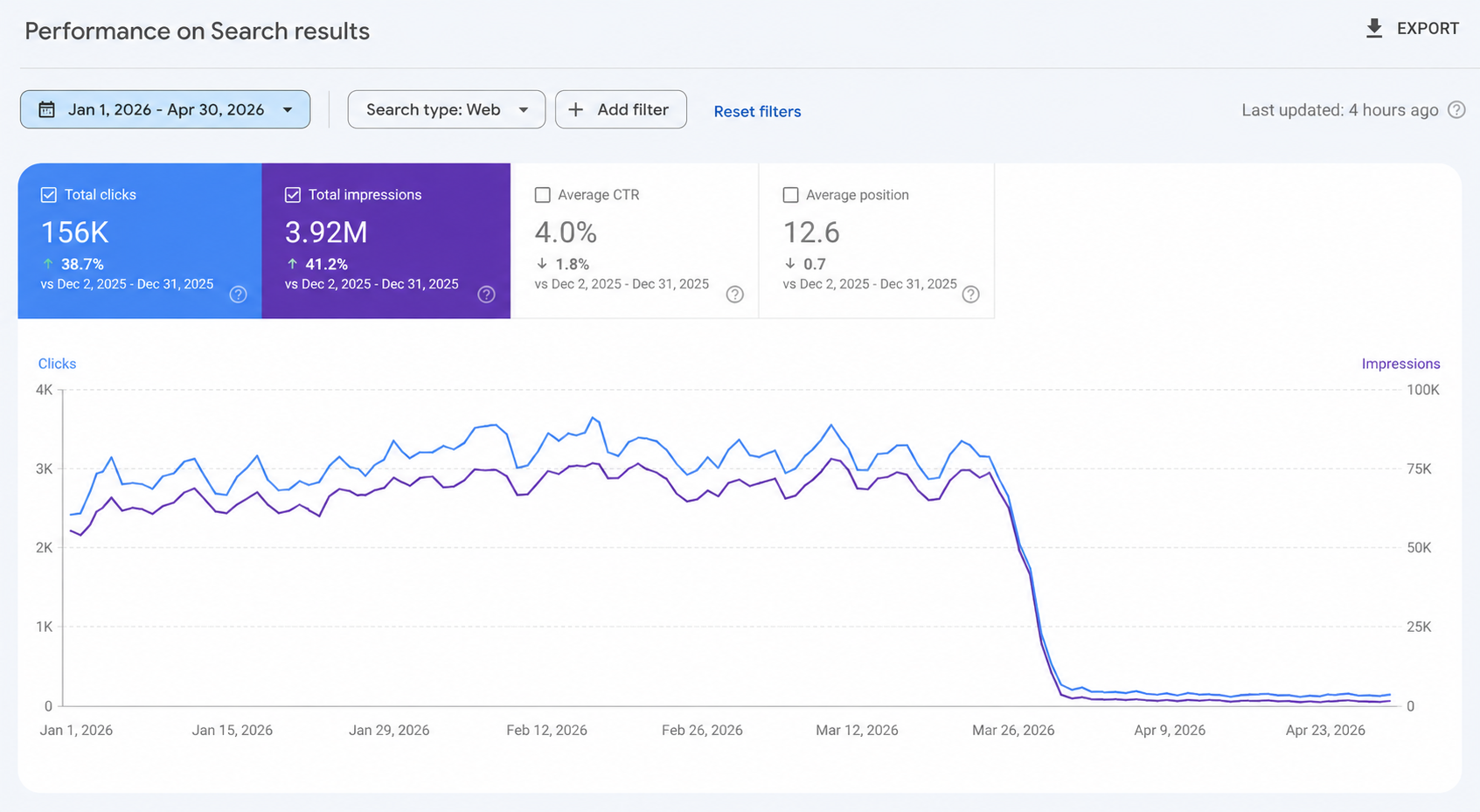
On March 24–25, 2026, Google rolled out a global spam update that completed in roughly 20 hours. It didn't introduce entirely new spam categories. Instead, it dramatically tightened enforcement of existing ones - especially scaled content abuse.
Under Google's updated spam policies, scaled content abuse now explicitly covers mass-produced web pages whose primary purpose is manipulating search rankings, whether created by AI, scripts, or manual workflows.
The key trigger isn't the production method - it's the outcome.
If thousands of programmatic urls share near-identical template structure with only superficial swaps (like city names or product titles), Google classifies them as spam.
Here's an example: a service business with 2,000 city-level pages built from the same page template, each swapping only the location name and a generic paragraph. Post-update, these doorway-style pages were quietly dropped from the index.
From Scale-First to Database-First: The New Foundation of Programmatic SEO
The fundamental shift in 2026 is simple: your underlying data is now your content.
Before designing a single page template or running keyword research, you need a robust data model, whether that lives in PostgreSQL, Airtable, BigQuery, or a headless CMS, capable of generating multiple pages from the same structured foundation.
Comprehensive, integrated data is necessary for effective programmatic systems. Each row in your database must map to a URL that contains something no other page on the internet offers.
Here's what a 2026-ready pSEO data schema includes:
Mandatory unique data column per row — every row must include at least one field that cannot be null and cannot be replicated across other rows (pricing, ratings, local market data, proprietary survey results); if that field can't be populated with genuine data, the page shouldn't exist
Freshness timestamps — a "data last updated" date rendered both in the visible HTML and in the structured data, tied to real data changes rather than deployment dates
Source references — sameAs links and clear attribution for each data point, since AI systems weigh entity signals more heavily when sources are traceable and verifiable
Field-to-block mapping — every database field tied to a specific visible section on the page, so nothing in the schema exists without a corresponding, user-facing reason
Here's what this looks like in practice: comparison pages pull real feature matrices and live pricing via API, integration pages document actual workflow recipes for each tool pair.
"[Service] in [City]" pages run on genuine local stats, not filler text. And "[Tool] in [Industry]" guides are built from real use-case data, generating multiple pages that each serve a distinct, verifiable purpose rather than duplicating the same thin template.
Wise is the clearest proof this model works at scale.
Ahrefs' own analysis found nearly 12,000 landing pages just for SWIFT code combinations targeting the US market alone, alongside thousands more for currency conversions and routing numbers, all built on the same template infrastructure.
No boilerplate variable swaps, just real financial data behind every page.
The workflow is simple, even if the execution isn't: audit your datasets first, design a content model for each page type, connect everything to your CMS via APIs, and only then build the templates.
Content Differentiation Signals: How to Avoid "Scaled Content Abuse"
Content differentiation signals are the measurable elements that prove each programmatic page is uniquely useful.
Think of them as what separates a legitimate directory from a spam farm: distinct datasets, calculations, user inputs, user-generated content, and external references that vary per URL.
Google has never published a numeric uniqueness threshold, but Danny Sullivan, Google's Search Liaison, has said the real test is intent: whether a page exists because a user would genuinely want it, or purely to capture search traffic.
Volume alone isn't the trigger, not even search volume: a keyword with high search volume doesn't justify a page if the underlying data can't support it.
The safer approach: every programmatic page should contain data that's genuinely specific to that page's query, not just template text with variables swapped in.
This starts with understanding search intent for each page type before you generate pages at scale, not after: a comparison query, a local service query, and a definitional query all demand different structures, and AI generated content that ignores this distinction tends to produce exactly the kind of thin content Google's spam policies target.
Here are some concrete differentiation tactics for key page types:
Comparison pages: Unique feature matrices pulled from real data sources, pricing deltas calculated per pair, and scenario-based recommendations ("Best for freelancers vs. agencies"). Don't just list features - compute differences.
Integration pages: Workflow recipes showing how two tools connect, automation examples with step counts and time savings, and "jobs-to-be-done" framing per tool pair.
Location pages: Real local pricing from surveys or APIs, regional regulations or licensing requirements, demand stats from public datasets, and landmarks or context from third-party sources.
Simply swapping {city} or {tool} in boilerplate copy is not enough. Our own working rule, built on that same logic: aim for more than 40% of visible content blocks to be page-specific.
If your page for "Notion vs ClickUp for freelancers" reads nearly identically to "Notion vs ClickUp for agencies," you haven't differentiated.
Every page needs to answer the specific query a real user typed, backed by data that page alone offers, or it risks the penalties this guide has already covered.
The instinct to generate pages for every keyword variant with meaningful search volume is exactly what leads to thin content at scale, and it's the pattern Google's March 2026 enforcement targeted directly.
Here are some supporting signals that strengthen differentiation:
Structured data markup per page type (Product, FAQ, HowTo, LocalBusiness)
Author or brand E-E-A-T - credit a real person or team for the analysis
Outbound citations - link to the data sources you used
Methodology sections - explain how you gathered, processed, or scored the data
Coherence Across Platforms: Website, Google Business Profiles, and Beyond
A major 2026 trend is cross-surface coherence. Search engines and ai search systems now cross-check signals across your website, google business profiles, social profiles, and review platforms. If your site says one thing and your GBP says another, trust erodes.
Here is a checklist for aligning location pages with GBP:
Link each location page directly from the corresponding GBP website field
Mirror service lists, opening hours, and service areas exactly
Embed GBP reviews or structured review snippets on each location page
Ensure meta descriptions match the business description in the profile
Entity-building tactics that support programmatic seo:
Add Organization and LocalBusiness schema to all your pages
Link out to official social profiles from your site
Maintain consistent brand descriptions across directories (Yelp, Apple Maps, Bing Places)
Programmatic strategies must utilize data from community platforms - pull review snippets, ratings, and Q&A content where licensing allows
Mini-example: a multi-location plumbing company with 45 service areas uses pSEO location pages, each linked from the corresponding GBP, each with unique local market data (average service costs, local licensing info, real customer reviews). These pages rank for "[service] near me" queries because every signal - site, GBP, reviews - tells a coherent story.
Technical Strength as a Ranking Prerequisite
In 2026, technical SEO is the gatekeeper for pSEO success. A beautiful data model and unique content mean nothing if Googlebot can't crawl, render, or index your pages efficiently.
Key technical priorities for large pSEO sites:
Core Web Vitals compliance: LCP ≤ 2.5 seconds, INP ≤ 200 milliseconds, CLS ≤ 0.1. As of the May 2026 CrUX release, only 55.9% of tracked origins globally pass all three metrics at once, even though individual pass rates run higher (68.6% for LCP, 81.3% for CLS, 86.6% for INP). A weak metric on just one of the three sinks the whole assessment. Aim to be in that top half, or better.
Clean URL structure: Logical hierarchies organized by page type (/comparisons/tool-a-vs-tool-b, /locations/city-name). No parameter-heavy or flat structures.
Scalable sitemaps: Break sitemaps by page type. Don't submit a single 50,000-URL sitemap. Use sitemap index files and ensure submitted pages reflect actual live content, not stubs.
CDN and caching: Use edge caching for static pages and pre-rendered programmatic content. Target TTFB under 100ms on primary pSEO clusters.
The "weakest-link" effect is real and documented by Google itself: crawl budget isn't allocated evenly per page, it responds to site-wide signals. If Google spends too much time crawling low-value or soft-404 pages, it may decide the rest of the domain isn't worth the crawl budget either.
In practice: a domain with thousands of thin or soft-404 programmatic pages can see its genuinely good pages crawled and indexed more slowly, simply by sharing a domain with the weak ones.
In this case, my reccomended monitoring practices are:
Log analysis to see actual Googlebot crawl patterns across page types
google search console API for tracking indexation rates per programmatic set
Automated checks for 404s, soft-404s, and redirect chains on programmatic urls
Regular on page seo audits of template-generated output
User-Friendly Programmatic Pages: UX as a Core Ranking Signal
"User-friendly" in the context of thousands of similarly structured pSEO pages means clarity, navigability, interactivity, and low friction. It's not just seo - it's product design. Consumers expect brands to understand their preferences by 2026, and programmatic SEO is shifting towards hyper-personalized, high-quality content.
UX patterns that work for programmatic content in 2026:
Faceted filters on directory and category pages - let users narrow results by price, rating, location, or feature
Sticky summary cards on comparison pages - keep the key takeaway visible as users scroll through detailed breakdowns
Interactive elements on integration pages - calculators, configuration widgets, or "build your workflow" tools that provide user context and keep visitors engaged
Responsive tables - readable on mobile with horizontal scroll or collapsed rows, not tiny text
Search engines reward pages that demonstrate expertise and usefulness. Strong UX reduces pogo-sticking, and this isn't just a soft correlation: Google's own VP of Search, Pandu Nayak, confirmed under oath during the DOJ antitrust trial that NavBoost, Google's click-based re-ranking system, uses signals like pogo-sticking directly to adjust rankings.
That said, this is distinct from what your analytics dashboard shows.
Google's own click-quality data (whether a user returns quickly to the search results after clicking) is what feeds the system, not "time on page" or "pages per session" as reported in Google Analytics, which Google has repeatedly said play no direct role in rankings.
Here are some mobile-first design essentials for pSEO templates:
Clear heading hierarchy (H1 → H2 → H3 matching the content structure)
Large tap targets (minimum 48x48px for buttons and links)
Tables that adapt gracefully to small screens
Fast-loading images with proper lazy loading and alt text
Logical navigation to related pages and parent category pages
Don't treat UX as an afterthought bolted onto a content template. Design the user experience first, then map your database fields into that layout.
Designing 2026-Ready Page Templates and Page Types
Key pSEO page types for 2026 include integration pages, comparison pages, directory/listing pages, localized service pages, use-case pages, and structured resource pages (checklists, calculators, mini-tools).
Each page type needs its own template structure designed around its data model and user intent.
Template design principles for the post-March-2026 landscape:
Clear mapping between database fields and visible UI blocks - every section on the page should trace back to a specific data field
Built-in sections for unique data (tables, charts, maps) plus editorial synthesis ("what this means," "when to choose option A vs B")
Minimum content quality thresholds - sufficient word count, at least two unique data widgets, and tailored CTAs per page type
Content must also be structured for conversational AI and zero-click search, giving high-value answers directly on the page rather than forcing a click to find them.
Example layout for a comparison page (top to bottom):
Hero section - H1 with both product names, one-sentence verdict, last-updated date
Key stats card - side-by-side pricing, rating, and category data
Feature comparison table - pulled from structured data, with highlights for differences
Scenario recommendations - "Best for teams under 10," "Best for enterprise"
FAQ section - 3-5 questions drawn from real search queries
Related pages links - other comparisons and category pages involving these products
Templates must be flexible enough to evolve (adding new fields or components) without regenerating all content.
Keep content and design layers decoupled: your CMS should pull from the database at render time, so updating a field updates all your pages instantly.
This is how programmatic SEO automates content creation at scale without sacrificing freshness.
Internal Linking Strategies for Programmatic SEO
Internal linking is the primary structural tool for massive pSEO sites in 2026: it distributes PageRank, clarifies topical clusters, and helps crawlers discover deep URLs — the same mechanism that lets Zapier's 40,000+ integration pages reinforce each other's authority.
Modern internal linking patterns:
Hub-and-spoke clusters - a main hub page (e.g., "CRM Integrations") links to thousands of "[CRM] + [tool]" integration pages. Each spoke links back to the hub and to 3-5 related pages within the cluster.
Cross-page-type linking - comparison pages link to individual pages for each product compared. Resource pages link to relevant tools. Category pages link down to individual pages and across to other category pages.
Rules to follow:
Cap links per contextual block to keep them natural, most practitioners land somewhere between 8 and 12 to avoid the block looking auto-generated
Vary anchor text naturally - don't repeat the exact target keywords in every link
Place contextual links in the body content, not just in footer or sidebar blocks
Use breadcrumbs to reinforce hierarchy
Ensure external links to authoritative sources appear on data-heavy pages for credibility
Avoid rigid, repetitive link blocks that appear across every page identically. Build rule-based internal linking systems that adjust link selections based on content relevance and freshness, not just page type.
High-Quality Data Sources: The Real "Content" in pSEO 2026
The differentiation signals covered above are about compliance: what keeps a page out of trouble with Google.
Data sourcing is about competitive advantage: what makes a page actually win against competitors
Post-March 2026, the quality and uniqueness of data sources is arguably the biggest moat for programmatic SEO.
It matters more than copywriting.
Your ability to gather data that competitors can't easily replicate is what makes programmatic pages perform.
Here are some high-value data sources:
Proprietary data - usage metrics, success rates, or benchmarks from your own product or user base
Partner APIs - real-time pricing, inventory, or feature sets from data partners
Public datasets enriched with your analysis - government statistics, open directories, or census data combined with your own scoring or commentary
AI systems show a strong, measurable preference for user-generated content and authentic experiences over generic brand content.
Reddit alone is now the single most-cited source across every major AI engine, at roughly 40% citation frequency, and user-generated content overall makes up about 20% of AI Overview sources, up sharply from a year ago.
If you can incorporate verified reviews, community Q&A, or real user-submitted data, your pages gain a differentiation layer that's hard to replicate.
Evaluation criteria for data sources:
Criterion | What to Look For |
|---|---|
Uniqueness | Not available to every competitor using the same API |
Freshness | Updated weekly or monthly, not annually |
Coverage | Enough rows to justify the page type at scale |
Legal compliance | Proper licensing, attribution, and privacy adherence |
Structured data is becoming more essential for AI interpretation. Mark up your unique data with structured data markup (Product, Review, FAQs) so both search engines and AI systems can parse and cite it.
A concrete example: a fintech site building comparison pages from card issuer APIs (APR, fees, rewards) enriched with proprietary user satisfaction data and community reviews. Each page combines three data sources into something no single competitor offers.
Aligning Programmatic SEO with Broader Digital Marketing
Programmatic SEO can't live in isolation in 2026. It should connect to and be supported by broader digital marketing activities: paid search, email, product-led growth, and social.
Practical integrations:
Use high-performing pSEO pages as landing pages for long-tail PPC campaigns. If your comparison page already ranks organically, a matching ad for relevant keywords compounds visibility.
Capture leads on high-intent comparison or integration pages and feed them into lifecycle email flows.
Repurpose pSEO data (benchmarks, rankings, local stats) into social content, reports, or newsletters.
User search behavior is diversifying across AI platforms and social forums.
Diversified traffic sources - direct, email, referral - on programmatic URLs signal genuine user value to search engines, the same signal that separates Wise's nearly 12,000 SWIFT-code landing pages from a doorway-page pattern.
A page that only gets search visits looks like it was built only for search engines.
Search engine optimization in 2026 isn't just SEO. It's about building assets that serve users across channels and generate value regardless of which algorithm changes next.
Programmatic SEO and AI Search: Getting Citable in 2026
Programmatic SEO is diversifying to appear in AI-driven search. Google AI Overviews, ChatGPT-based engines, and Perplexity are reshaping how users find information - fewer "10 blue links," more synthesized answers. AI citations and visibility in AI-generated answers are becoming critical performance indicators.
How to make pSEO pages citable by AI:
Clear question/answer sections - structure FAQ blocks so AI can extract direct answers
Structured headings and schema - FAQ, HowTo, Product, and Organization markup help AI systems parse your content
Unique statistics and benchmarks - LLMs cite pages that offer data not found elsewhere
Calculators and tools - interactive elements that produce unique outputs per query
Content is tailored for easy retrieval, synthesis, and citation by AI models. Businesses must shift KPIs to visibility within AI summaries and chatbots, not just traditional search engine results.
Focus programmatic seo efforts on queries where AI still sends significant click-through: complex decisions (comparison pages), pricing trade-offs, local service options, and interactive tools. Pure definitional queries ("What is CRM?") are increasingly zero-click dead ends.
Other Emerging Programmatic SEO Trends in 2026
Beyond the core trends, several additional shifts are reshaping how teams approach scaling programmatic SEO:
Conservative indexation strategies. Publish fewer, higher-value pages. Use noindex on borderline sets rather than hoping thin static pages will rank. Quality over quantity is the new default.
"Pages as products" mindset. Each pSEO page type is treated like a mini-product with its own roadmap, KPIs, and user feedback loops. Teams track engagement metrics per page type - not just total organic traffic - and iterate templates based on performance data.
Automated QA and LLM-based auditing. Teams use AI to audit content quality, check policy compliance, and flag factual inconsistencies across thousands of pages before publishing. This catches issues that manual review at scale cannot.
Multi-lingual pSEO. Expanding programmatic pages across languages is more viable but requires per-country data and cultural adaptation - not pure translation. A "[service] in [city]" page for Milan needs Italian-specific regulations, not a Google Translate pass of the English version.
Mixed-media programmatic content. The shift from pure text pages to embedded videos, maps, calculators, and interactive components as core differentiators. Pages that create pages around a single data table are losing ground to pages that present that data through multiple formats.
Programmatic SEO targets long tail keywords effectively across verticals - but in 2026, the smartest teams also map those keywords to user context signals (device, time of day, location) to serve more relevant experiences.
Practical 2026 pSEO Implementation Roadmap
Before you start: pSEO only works if you have, or can build, a genuine data advantage. If your only 'unique' data is a keyword list, stop here and invest in data acquisition first. Everything below assumes you've cleared that bar.
Here's a concise, step-by-step roadmap for launching or rebuilding a programmatic SEO strategy in the post-March 2026 environment:
Step 1: Audit existing programmatic pages. Use Search Console to identify which of your submitted pages are actually indexed versus stuck in limbo. Flag any page type that shares more than 60% identical content across URLs. Remove or noindex thin sets.
Step 2: Identify page types worth building. Pick 1-2 page types where you have unique data and clear search demand. Don't try to create pages for every pattern at once. Prioritize comparison pages, integration pages, or location pages where you hold proprietary data.
Step 3: Build your database. Gather data from APIs, internal sources, and public datasets. Structure it with mandatory unique fields per row, freshness timestamps, and source references. You need a real data layer, not a spreadsheet of keyword variations.
Step 4: Design and test templates. Map database fields to visible UI blocks. Include sections for dynamic data, editorial synthesis, FAQs, and meta descriptions tailored per page. Test the template with 5-10 sample pages before scaling.
Step 5: Pilot 50-200 URLs. Publish a controlled batch. Monitor indexation, search rankings, and engagement metrics in Google Search Console and analytics for 2-4 weeks.
Step 6: Iterate and scale. Based on pilot data, refine templates, prune underperformers, and expand to the full dataset. Continue monitoring with SEO tools and log analysis.
Checkpoints along the way: keyword research validation at Step 2, data source quality check at Step 3, technical SEO audit at Step 4, UX testing at Step 5, and internal linking implementation at Step 6.
Start small. Iterate based on data. Scale what works.
Building Durable Programmatic SEO Beyond 2026
Post-March 2026, winning at programmatic SEO comes down to five pillars: database-first architecture, differentiated content, platform coherence, technical strength, and user-friendly experiences. These aren't temporary tactics, they're the foundation of search engine optimization that endures algorithm changes.
Aligning with Google's updated spam policies protects long-term visibility and eliminates the risk of sudden, catastrophic traffic loss. The pattern holds across every real example in this guide: Zapier, Wise, and every site that survived March 2026 built pages around unique, structured data first and templates second, not the other way around.
Treat every programmatic page type as a long-lived asset tied to real user problems, not as a quick tactic for keyword coverage. The era of spinning up 10,000 near-identical web pages and hoping for the best is definitively over.
Your next move: audit your current programmatic setup this week. Identify one or two high-potential page types where you hold proprietary data or can build a real data layer. Rebuild those first. Let the results guide your expansion.
The sites that thrive beyond 2026 will be those that treat every programmatic URL as a product: backed by real data, designed for real users, and built to last.